The flooring market is undergoing a transformation that goes beyond mere changes in trends. The expectations of individuals are shifting: aesthetics remain a driving factor for purchase, but technical resistance and environmental considerations now weigh equally in the final decision. Parquet, large-format tiles, next-generation vinyl, or resin: the options are multiplying, along with the selection criteria.
Matte and textured finishes: why smooth floors are declining
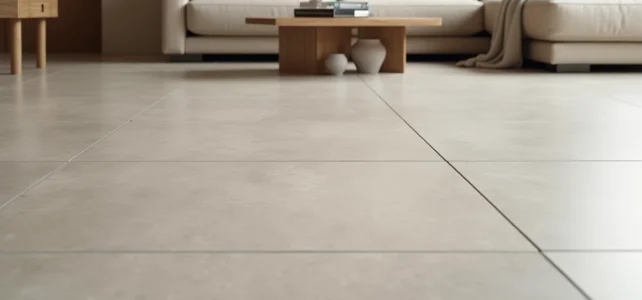
Uniform and shiny surfaces are losing ground in favor of finishes that emphasize relief. Matte, brushed, or slightly textured coatings are becoming commonplace in recent collections. The goal is no longer just visual: textured finishes better conceal micro-scratches and marks from daily use.
This sensory shift concerns both tiles and parquet. In porcelain stoneware, manufacturers offer surfaces that replicate the feel of raw stone or polished concrete, with a more “alive” appearance than a polished slab. On the wood side, oiled finishes are replacing satin varnishes, as they preserve the natural grain of the wood species while simplifying localized touch-ups.
Field feedback varies regarding the ease of maintenance of these textures in kitchens or entryways, where dirt tends to cling more in the micro-reliefs. The choice of the room remains a parameter not to be overlooked before finalizing a very structured finish.
To explore the materials and styles that dominate this season, several resources compile the available options, such as trendy floors on Salon Tendances Habitat, which details the major categories of current coverings.
Graphic layouts and Versailles tiles: the floor becomes a decorative element in its own right
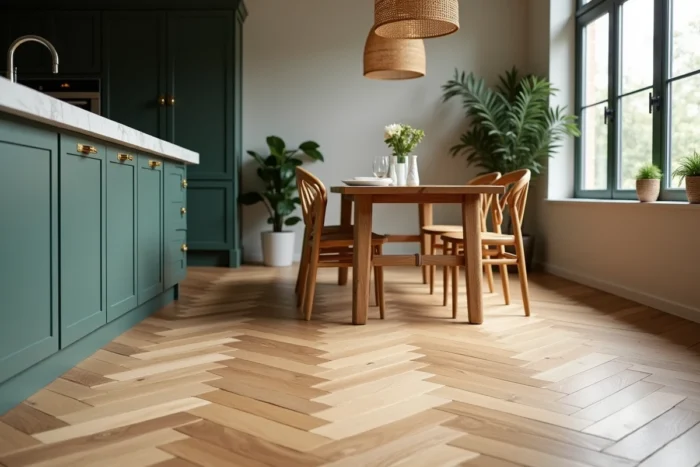
The classic straight layout, plank by plank, is no longer the default reflex. Geometric patterns and Versailles tiles are making a comeback in renovation and new construction projects. This return to more elaborate layouts marks a change in the status of the floor: it no longer merely supports furniture; it visually structures the space.
The herringbone and Hungarian point layouts remain the most requested, but more complex compositions are emerging. Some combine two wood species or two shades to create a contrast directly on the floor, without resorting to a rug.
Technical constraints to anticipate
A graphic layout requires impeccable substrate flatness. Versailles tiles, assembled in square panels, demand a perfectly flat surface to avoid visible offsets at the joints. The amount of waste also significantly increases compared to a random layout.
- The herringbone layout generates an excess of material to account for, as each plank is cut at an angle at both ends
- Versailles tiles require precise planning before ordering to avoid unsightly joints at the room’s perimeter
- Installation time increases: an experienced installer progresses significantly slower on a geometric pattern than on a standard straight layout
These constraints explain the budget gap between a classic installation and a decorative one, a point rarely detailed in articles that present these patterns as a mere aesthetic option.
Durability and “zero maintenance”: the technical criterion that weighs as much as style
The demand for durability is no longer limited to terrace or garage floors. In living spaces, resistance to stains, UV rays, and wear has become a central selection criterion, on par with color or format. Manufacturers of rigid vinyl and porcelain stoneware now communicate as much about mechanical performance as about visual appeal.
SPC vinyl (Stone Polymer Composite) exemplifies this trend well. Dimensionally stable, moisture-resistant, and compatible with underfloor heating, it meets the demand for a “maintenance-free” floor that appeals to busy households. However, its ability to age gracefully over a long period remains debated: unlike solid wood, it cannot be refinished by sanding.
Recyclable materials and eco-design
Environmental sustainability is shifting from a marketing argument to a design constraint. Mentions of recyclable materials, low-VOC adhesives, and short manufacturing circuits are multiplying in product sheets. Several ranges of tiles now incorporate a percentage of recycled material in their composition.
This evolution also modifies the decisions of interior architects. A locally produced porcelain stoneware floor made with European clays may be preferred over exotic parquet, whose carbon footprint related to transport weighs heavily on the overall environmental impact of the project.
Large-format tiles and visual continuity in open spaces
Large tiles continue to gain ground in open kitchens and living rooms. The principle is simple: fewer visible joints create an impression of continuous space, particularly effective in modestly sized homes.
Rectangular elongated formats dominate catalogs, but square tiles exceeding one meter on each side are also appearing. These very large formats raise concrete logistical questions:
- The unit weight of each tile makes handling delicate and often requires two people for installation
- On-site cutting requires specific tools that not all tilers possess
- Even the slightest defect in substrate flatness results in noticeable movement underfoot
The large format does not forgive approximation. Careful leveling and systematic double gluing are the minimum conditions for a result that lives up to the aesthetic promise.
The choice of a floor in 2026 hinges on three simultaneous axes: visual appeal, technical performance, and environmental footprint. No single material ticks all the boxes, making the intersection of room usage, renovation budget, and decorative ambition more crucial than ever.