
In a residential electrical panel, type A and type AC residual current devices coexist on the same DIN rail, but they do not protect against the same types of faults. The NF C 15-100 standard requires a minimum of two residual current devices per dwelling, at least one of each type. This regulatory requirement is based on a specific technical reality, related to the nature of the leakage current that each device can detect.
Smooth DC component: the fault that type AC cannot see
A type AC residual current device detects sinusoidal alternating current leaks. This is the type of leak produced by classic resistive devices (heaters, incandescent lighting, resistance water heaters). Its detection technology, based on a magnetic toroid, works perfectly as long as the leakage current maintains this symmetrical waveform.
The type A device, on the other hand, detects the same alternating currents, but also leakage currents with a smooth DC component. These currents appear at the output of switch-mode power supplies, variable speed drives, induction cooktops, or electric vehicle charging stations. The waveform rectified by the power electronics loses its symmetry and can “blind” a type AC residual current device, which then does not trip in the event of a fault.
To delve deeper into the difference between a type A and type AC circuit breaker, it is essential to remember this fundamental point: type A does not replace type AC; it covers a broader spectrum of faults, suitable for modern electronic equipment.
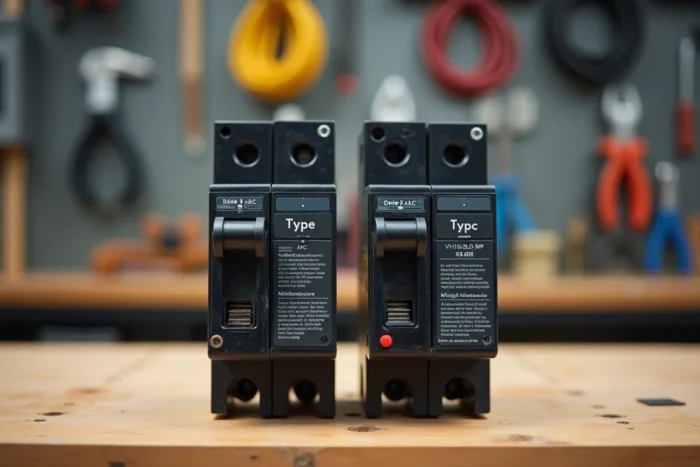
Circuits required under type A by the NF C 15-100 standard
The standard explicitly designates the circuits that must be connected under a type A residual current device. This list is not indicative; it conditions the compliance of the installation during the CONSUEL inspection.
- The circuit powering the cooking plates or electric stove, due to the power electronics integrated into induction hobs
- The circuit dedicated to the washing machine, whose variable speed motor generates leakage currents with a smooth DC component
- The circuits powering an electric vehicle charging station (unless a specific protection device type B or type F is installed upstream)
The application guides published by Promotelec and CONSUEL after the A5 amendment of the standard indicate a trend to extend the use of type A to other circuits, particularly kitchen outlets likely to power high-power electronic devices. This recommendation does not carry strict obligation, but field feedback varies on this point: some CONSUEL inspectors already require a type A on these circuits in new housing.
Type AC in new housing: a usage that is decreasing
Type AC remains authorized by the standard for lighting circuits, standard outlets in living areas, roller shutters, or water heaters. In practice, the proportion of household equipment generating DC components increases each year. Even a simple LED fixture with an integrated dimmer or a robot vacuum cleaner includes a switch-mode power supply.
Recent technical catalogs from Schneider Electric, Hager, and Legrand document this evolution. Manufacturers offer pre-wired panels where the share of rows under type A exceeds that of rows under type AC, which would have seemed oversized just a few years ago.
Should we switch to all type A?
Nothing in the standard prohibits it. A type A residual current device protects just as well as a type AC on a purely resistive circuit. The additional cost compared to an AC model is just a few euros per module. For a new installation, equipping the entire panel with type A offers a safety margin against the evolution of connected devices.
However, in an existing compliant installation, replacing a functional type AC has no normative justification. The question arises only when adding a circuit (charging station, heat pump, new kitchen circuit) or renovating the panel.

Residual current device or differential circuit breaker: a frequent confusion
The terms “differential circuit breaker” and “residual current device” refer to two distinct devices. The residual current device protects people against indirect contacts (leakage current to the ground). The differential circuit breaker adds to this function protection against overcurrents (short circuits and overloads).
In a residential panel, the standard configuration associates a residual current device at the head of the row with downstream circuit breakers. The type A or AC qualifies the differential detection, whether it is provided by a residual current device or a circuit breaker. A type A differential circuit breaker thus combines protection for people (including DC components) and protection for the circuit against overloads.
The differential circuit breaker costs significantly more than a simple residual current device. Its use in residential settings is mainly justified on critical circuits where a targeted cut-off is preferable to cutting off the entire row (freezer, alarm, IT).
Sensitivity 30 mA and rating: other parameters not to overlook
The choice between type A and type AC does not exempt from checking two other characteristics of the residual current device:
- Sensitivity, set at 30 mA for all residential circuits by the NF C 15-100, without exception
- The rating in amperes, which must be greater than or equal to the rating of the main circuit breaker and compatible with the sum of the protected downstream circuits
- The number of modules per row, which conditions the maximum number of downstream circuit breakers that can be connected under each residual current device (eight circuits maximum per residual current device according to current recommendations)
An insufficiently rated type A residual current device will trip due to thermal overload even before a differential fault occurs, masking a sizing problem with a misleading symptom.
The choice between type A and type AC boils down to a question of suitability between the nature of the protected circuits and the detection capacity of the residual current device. For a new installation, prioritizing type A across the entire panel simplifies design and anticipates the increasing electrification of homes. In an existing installation, the priority remains to verify that circuits with DC components (induction, washing machine, charging station) are properly connected under a type A compliant with the standard.