
A floor that sags indicates a loss of load-bearing capacity of one or more elements of its structure: joists, beams, wall supports, or slab. The phenomenon can remain stable for decades in an old building or accelerate within a few months if an active cause (moisture, infestation) is not addressed. Understanding the mechanism before observing the symptoms helps avoid two common mistakes: panicking over an old stabilized deformation or ignoring a recent sagging that is progressing.
Termite and dry rot diagnosis: what regulatory checks do not cover
Before even discussing visible signs, one point needs clarification: regulatory diagnostics related to the sale of a property do not replace a structural inspection of the floor. The regulatory termite diagnosis only concerns termites and the visible and accessible parts during the visit. It does not look for wood-destroying fungi, joist defects, or overload.
For dry rot, the information required in areas defined by decree indicates a geographical risk, not the actual condition of the property. In other words, a property sold with compliant diagnostics may very well harbor a floor that is severely degraded beneath the surface.
This gap between the regulatory perimeter and structural reality explains why identifying the causes of a sagging floor often requires a supplementary examination, focused on all load-bearing wooden elements.
Biological attacks on wood: termites, wood-boring insects, and fungi
The wood of a floor can be attacked from the inside without the surface showing any apparent damage. Termites, in particular, tunnel galleries while maintaining a thin outer layer intact. The absence of holes or sawdust does not rule out advanced degradation. Only a mechanical probe (punch, hammer) or a professional examination can verify the actual condition of a suspicious joist.
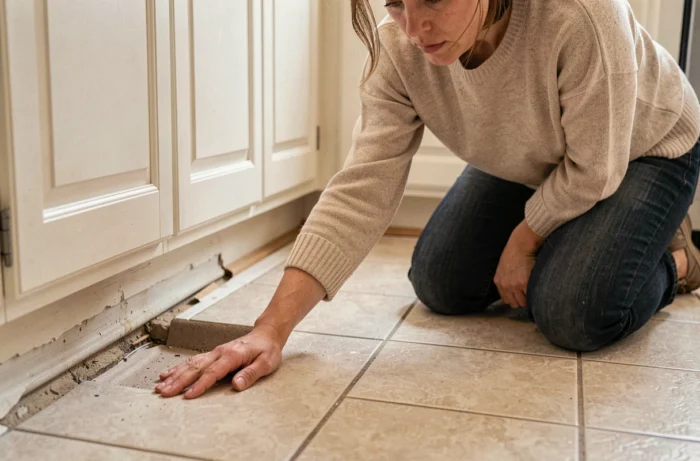
Other wood-boring insects (longhorn beetles, woodworms) leave more visible signs: exit holes, powdering, surface galleries. Their presence gradually weakens the load-bearing section of the wood, reducing its resistance to loads.
As for fungi, dry rot remains the most destructive threat. It develops in a confined, humid, and poorly ventilated environment. Its ability to penetrate masonry to reach other wooden areas makes its spread particularly difficult to contain once established.
Warning signs to watch for in at-risk areas
- Wood that sounds hollow when struck with a hammer, even without visible surface marks, may indicate a termite attack or the beginning of internal rot.
- Whitish or brownish filaments on walls, baseboards, or under the floor signal a possible fungal colonization, particularly in basements and crawl spaces.
- A persistent musty odor in a room, combined with a floor that flexes underfoot, suggests a moisture level conducive to wood-destroying fungi.
- Small piles of fine sawdust at the base of walls or under furniture reveal the activity of adult wood-boring insects emerging.
Moisture and ventilation: the often-underestimated triggering factor
The majority of biological attacks on wood share a common prerequisite: prolonged excess moisture. A wooden floor maintained in a dry and ventilated environment withstands aging much better than a floor exposed to rising damp, leaks, or an unventilated crawl space.
The Quality Construction Agency recommends limiting exposure to water, regularly maintaining wood, and monitoring signs of attack. For new constructions, it emphasizes the importance of treating cuts and notches in the wood and keeping treatment certificates.
In renovations, prevention involves concrete actions:
- Check that the crawl space has sufficient and unobstructed ventilation openings.
- Quickly address any plumbing leaks or roof infiltrations, even minor ones, before they reach load-bearing elements.
- Avoid installing a waterproof covering (glued tiles, vinyl without a breathable underlayment) directly on an old wooden floor without checking the moisture level of the substrate.
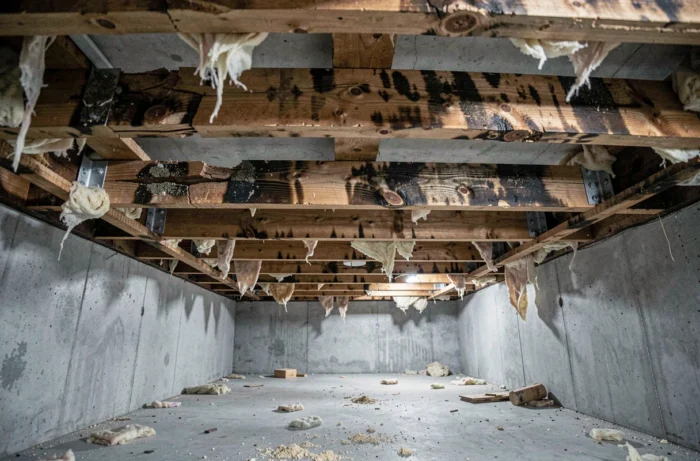
Overload and structural modification: mechanical causes not to be overlooked
A floor designed for typical residential use is not intended to support any load. Adding a heavy partition, a filled bathtub, a cast iron stove, or a dense bookshelf can create a localized overload that exceeds the capacity of the joists.
The problem also arises during renovation work. Removing a load-bearing wall or a partition that served as an intermediate support alters the span of the joists. A joist that worked over three meters ends up cantilevered over five meters, with a deflection (deformation) that increases significantly.
How to distinguish an old sag from an active problem
In houses built before the 1950s, a slight slope of the floor is often a legacy of initial settling. The wood has deformed under permanent load and then stabilized. This type of old deformation no longer progresses and generally does not present an immediate structural risk.
An active sag, on the other hand, is characterized by measurable evolution: doors that start to rub when they previously closed well, new cracks in the ceiling of the lower floor, or a low point that worsens season after season. Documenting these changes (dated photos, laser level measurements) forms the basis of a useful diagnosis before consulting a structural expert.
The distinction between stable deformation and evolving sag determines the urgency of intervention. An old floor that tilts a few millimeters per meter without evolving can simply be leveled or shimmed. A progressing sag requires addressing the cause (moisture, infestation, overload) before any surface repairs, lest the problem reappear quickly.