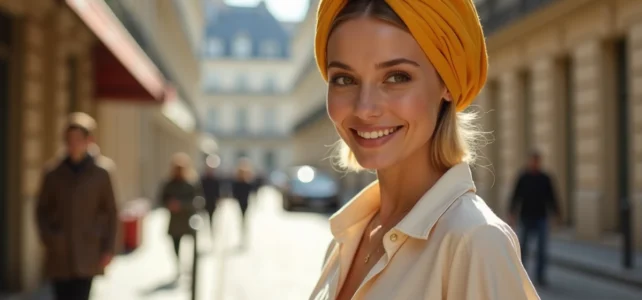
On a a rushed morning, a flat outfit, and three minutes in front of the mirror: it’s often in this kind of situation that the turban finds its place. This hair accessory transforms a basic look into a composed silhouette, without requiring elaborate hairstyling techniques. Adopting the turban in everyday life is primarily about solving a concrete style problem with minimal effort.
Turban and professional context: what no one details
We often think of the turban as a weekend or vacation accessory. In reality, the first question that arises is the context in which it is worn. In France, the professional context largely influences the choice of turban, its material, color, and volume.
In the private sector, there are no general rules prohibiting a hair accessory. A tone-on-tone silk turban with an office outfit passes without difficulty in most environments. Feedback on this point varies according to corporate cultures, but a simple and well-tied model is rarely an obstacle.
For public service agents, the question of dress neutrality may arise depending on the position held. It’s better to inquire in advance. A turban worn as a fashion accessory does not have the same interpretation as a religious head covering, but the boundary remains blurred in certain administrative contexts.
The practical reflex: one chooses first based on where one spends the most time during the day. Formal office, remote work, outdoor job, each setting guides towards a different tying style and material. The models offered on madame-turban.fr precisely cover this diversity of uses, from the discreet pre-tied turban to the more assertive model.
Choosing the material of the turban according to the season and hair type
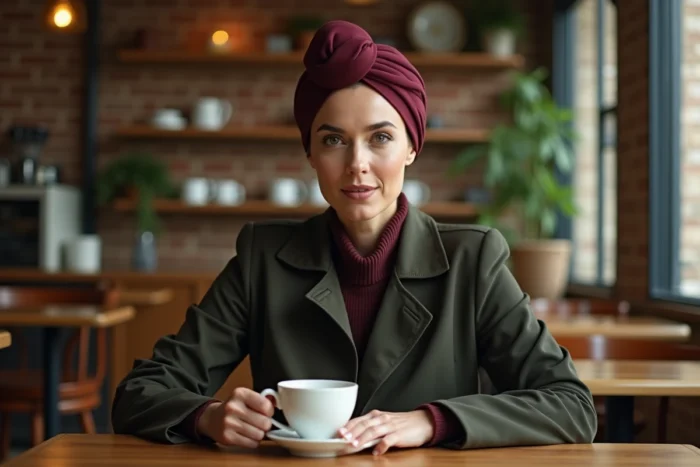
The material determines everything: comfort, hold on the head, and visual effect. One does not wear the same fabric in the height of summer and under a winter coat.
Silk and satin for the beautiful days
A silk or satin turban slips less than one might think if the tying is correct. These materials bring an immediate shine to the outfit. Satin is particularly suitable for curly or frizzy hair because it limits friction and preserves moisture in the lengths.
On straight hair, satin tends to slip. One compensates with a thin headband or net base, placed under the turban to create grip. It’s a simple trick that changes everything.
Cotton and linen for autumn-winter
Cotton offers better natural grip. It stays in place without additional accessories and absorbs sweat. For the cold months, a thick cotton jersey or blended linen turban protects the ears while structuring the silhouette.
- Fine and straight hair: prefer textured cotton or jersey, which grips better without tightening
- Thick or curly hair: satin or silk preserves volume and avoids crease marks
- Short or shaved hair: all materials work, but a fabric with a bit of stiffness (linen, thick cotton) gives more structure to the turban
Multi-occasion turban: from urban look to dressed outfit
The main interest of the turban in 2026 is its ability to transition from one style to another without changing accessories. One ties it differently, adjusts the volume, and the silhouette shifts.
The same turban can dress up a pair of raw jeans in the morning and an evening gown. The difference lies in three parameters: the height of the tying, the number of turns, and how one allows (or not) the tips of the fabric to protrude.
Low and relaxed tying for everyday
For an urban look, one wraps the fabric close to the nape with a simple knot on the side. The volume remains contained. This style works with a t-shirt, a denim jacket, and sneakers. No need for elaborate patterns: a solid cotton turban in a color that contrasts with the top is enough to create a focal point.
High and structured tying for events
One raises the turban to the top of the head, multiplies the turns to create volume. A patterned silk square scarf, folded into a triangle and then wrapped, gives a sophisticated result. The high turban elongates the silhouette and replaces a headpiece at a wedding or an evening event.
Pairing the turban with your outfit without style mistakes
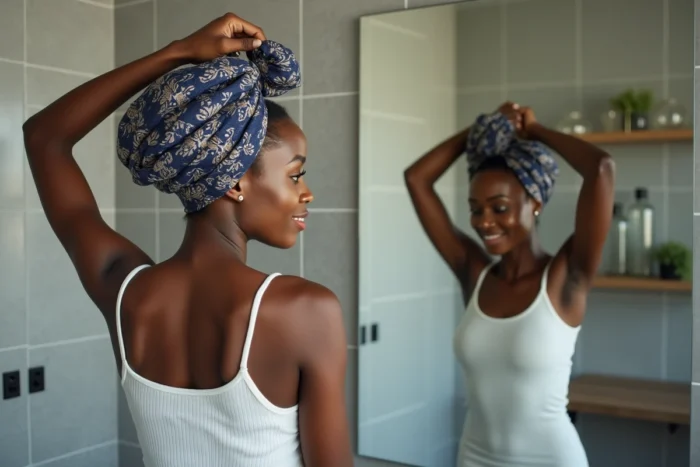
The turban is a strong accessory. It draws the eye to the face and upper body. This property imposes some rules of association to avoid visual overload.
- Patterned turban: wear it with a solid top. The contrast works better when the rest of the outfit remains understated
- Solid and colorful turban: it can dialogue with an accessory of the same chromatic family (earrings, bag, belt) without the whole looking costumed
- Shiny silk turban: avoid other satin pieces in the outfit. Only one shiny element at a time keeps the balance
- Wide and voluminous turban: lighten the rest, no imposing necklace or XXL earrings
The current trend also leans towards hybrid uses. We increasingly see the turban paired with a cap or integrated into a scarf worn as a wide headband. These combinations work especially in a streetwear or bohemian context, less so in a formal setting.
The turban requires neither technical skill nor a specific wardrobe. It just requires identifying the right fabric for one’s hair type, the right volume for the occasion, and the right color for the outfit. Once these three parameters are set, it becomes a daily reflex rather than a style effort.