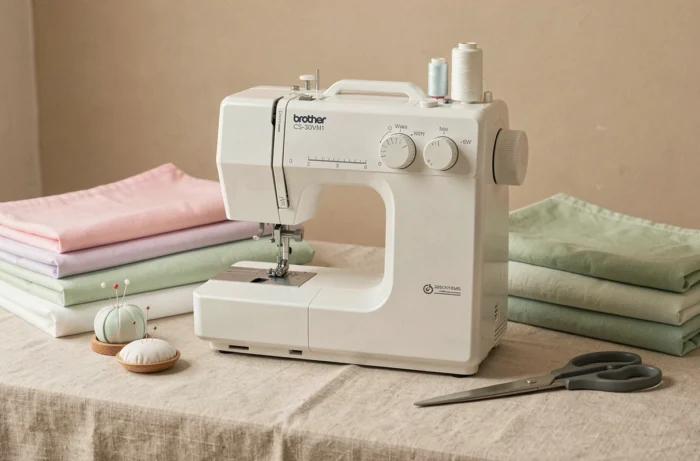
The Brother CS-10VM1 belongs to a family of models (CS10, CS10s, CS10VM1) often grouped under the same commercial label. This shortcut can be misleading: the exact model number on the rating plate determines which accessories are included, the firmware version and which replacement parts are compatible. Before buying, check the model suffix in the manual to avoid compatibility issues when replacing a presser foot or needle plate.
CS-10VM1, CS10s, CS10: model-number confusion and technical implications
Several retailers group the CS10, CS10s and CS10VM1 into the same range, but this does not prove that all accessories or specifications are interchangeable. On an entry-level electronic machine, a firmware difference can affect speed-control behavior or the sequence of available stitches.
In practice, we recommend checking the model number printed on the chassis against Brother’s database (accessible using the serial number). This is the only way to confirm compatibility with a walking foot, an invisible zipper foot or a specific bobbin.
A third-party product listing may well use the CS10s specifications (stitch count, power, dimensions) and attribute them to the CS-10VM1. If you’re interested in the Brother CS-10VM1 sewing machine, comparing the official manual with the retailer’s listing is still the most reliable approach.
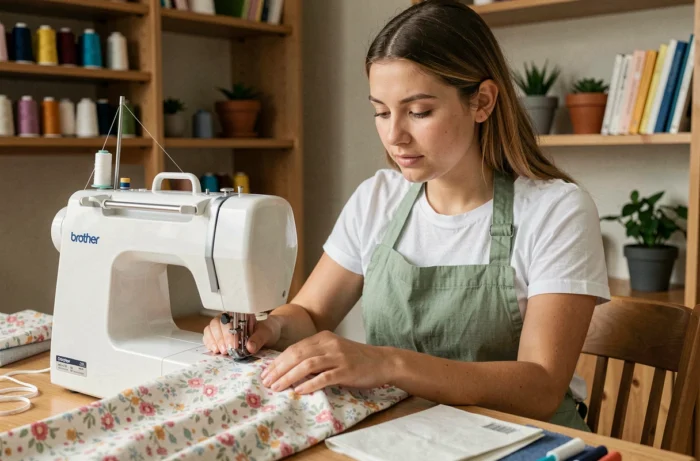
Brother CS-10VM1 vs. an entry-level mechanical machine: thick fabrics, jersey and repairs
An electronic machine like the CS-10VM1 offers fine adjustment of thread tension through its built-in electronics. On an entry-level mechanical machine, tension is adjusted manually and less precisely, which can lead to uneven stitches whenever fabric thickness changes.
Thick fabrics: denim and canvas
The motor power of an electronic Brother machine in this range lets it sew through several layers of denim, provided you use a suitable needle (90/14 or 100/16). A low-end mechanical machine often struggles to maintain consistent feeding beyond three layers because the feed dogs do not apply enough pressure.
The standard presser foot on the CS-10VM1 lifts high enough to accommodate substantial fabric thickness. Check the maximum presser-foot lift in the manual for your exact model.
Jersey and stretch knits
The CS-10VM1 has stretch and zigzag stitches. For lightweight jersey, a rounded-tip needle (such as a ballpoint needle) is essential, regardless of the machine. Electronics cannot make up for using the wrong needle on stretch fabric.
An entry-level mechanical machine also offers a zigzag stitch, but without automatic tension stabilization. As a result, jersey is more likely to pucker, especially at the start of a seam.
Common repairs
Both types of machines can handle hemming trousers or repairing a seam. The electronic model’s advantage is its consistent stitching at low speeds, which is useful for beginners who sew slowly.
Repairability and Brother after-sales service: what the regulations actually cover
France’s repairability index does not apply to every product category. Sewing machines are not included in the list of categories covered by this index. So the absence of a repairability score for the CS-10VM1 does not mean that the machine is difficult to repair or that it is deliberately exempt from an obligation.
At the European level, Directive 2024/1799 provides for a repair obligation for certain product categories and a 12-month extension of the legal guarantee if the consumer chooses repair. The source consulted states that the categories concerned include certain household appliances, but does not establish that sewing machines are among them. It would be premature to promise this benefit for the CS-10VM1.
However, Brother’s authorized repair network remains available for mechanical parts (feed dogs, rotary hook, motor belt). If an electronic board fails, component availability depends on whether the model remains in Brother’s catalog, which may become a concern after a few years on the market.
- Before buying, check the availability of spare parts for the exact CS-10VM1 model directly with Brother customer service or an authorized retailer
- Keep the receipt and manual for any claim under the legal guarantee of conformity (two years in France)
- Factor in the cost of an annual service (cleaning, oiling and tension check) if you regularly use the machine on thick fabrics
Stitches and features: what beginners actually use for creative sewing
Brother’s CS10 range offers dozens of stitches. In practice, beginners doing creative sewing use only a handful of stitches regularly:
- Straight stitch: the foundation of any seam, used for most projects
- Zigzag stitch: finishing raw edges, sewing elastic and adding decoration
- Stretch stitch: seams on jersey and stretch fabrics; a partial substitute for a serger on small projects
- Automatic buttonhole: an advantage of electronic machines, with the size set in one step rather than through several passes on a mechanical machine
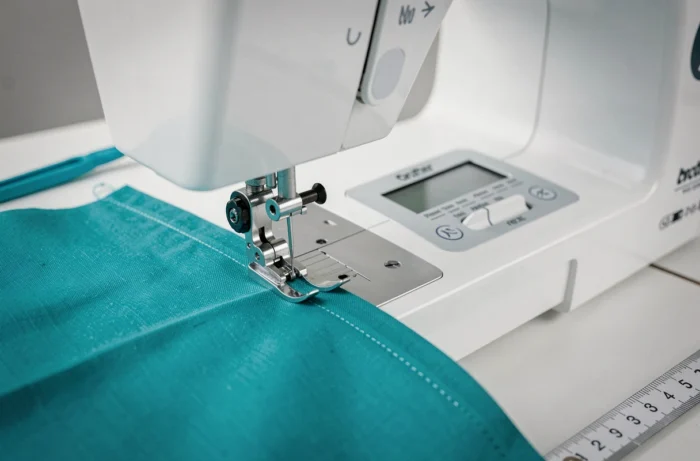
Decorative stitches (scallops, waves and novelty patterns) are useful for customizing fabric and decorating pouches or bags. A built-in needle threader and LCD screen make the machine easier to use for someone who has never threaded one before.
The free arm, revealed by removing the accessory compartment, makes it possible to sew tubular items such as sleeves and trouser legs. It is standard on machines in this price range and is also found on entry-level mechanical models.
What to know before buying the CS-10VM1
The CS-10VM1 is no substitute for a serger when it comes to professional finishes on knit fabrics. It is not suitable for thick leather or technical multilayer fabrics without risking a broken needle or a jam.
The plastic chassis, common in this price range, vibrates more than a metal chassis at high speeds. This is worth considering for extended sessions with heavy fabrics.
Because the machine relies on electronics, a motherboard failure makes it unusable, whereas a mechanical machine can often be repaired with generic parts. The choice between an electronic and a mechanical machine depends on the projects you have in mind, not on one being inherently superior to the other.
For beginner creative sewing projects (pouches, tote bags, simple garments and customization), the CS-10VM1 covers a wide range of needs. If your projects are limited to repairing workwear or sewing heavy upholstery, consider a sturdy mechanical machine with a metal chassis as an alternative.