
A hollow-sounding white wall, a soulless hallway, a well-stocked but flat-looking shelf: we all know that moment when a room works but doesn’t really feel like us. Personalizing your home doesn’t require a big budget or major renovations—just a few thoughtful touches that set the mood. Here are some creative decorating ideas focused on real-life situations, the kind we actually encounter when we want to add character to our space.
Decorative reuse: find a secondhand piece of furniture to create a focal point
You walk into a living room where everything is new and coordinated, yet nothing catches your eye. It’s missing an object with a story to tell. Reuse solves this problem: a secondhand piece of furniture instantly becomes a focal point, thanks to its patina, shape, or detail that you won’t find in any catalogue.
An antique chest of drawers placed beneath a contemporary mirror creates a contrast in styles that draws the eye. You could also repurpose a solid wood workbench as an entryway console. The idea isn’t to fill your home with vintage pieces, but to choose one standout item for each space.
For anyone who enjoys hands-on projects, home decor ideas on Mulot Bricole brings together useful resources to help you get started. Reuse also works as an aesthetic choice in its own right: the unique character of an old object personalizes a home far more than a mass-produced accessory.
Before buying, check that the piece can be repaired and, if possible, adapted. A sideboard with replaceable handles or doors that can be repainted will suit a future move or change of style. Choosing furniture that can be taken apart or adapted helps you avoid being stuck with an inflexible piece.

Color and air quality: choose decorative paint without overlooking health
Repainting one wall is still the quickest way to transform a room. Sage green in a home office, terracotta behind a bed, slate blue in a hallway: color sets the mood and defines zones without the need for extra furniture.
We often think about the shade, but rarely about what the paint releases into the air. In France, indoor air emissions are rated from A+ to C. A+ is the minimum rating to look for, although it doesn’t guarantee everything: room ventilation, the amount of new materials, and the size of the space also matter.
Use color without overwhelming the room
In most rooms, painting just one wall is enough. If you’re torn between two shades, limit the palette to a maximum of three colors per room (walls, textiles, and furniture). This simple rule makes every subsequent decision easier.
On an accent wall, matte finishes absorb light and add depth. Satin finishes reflect more light and work better in small, dark rooms. The right choice depends on the room’s natural light, not just personal taste.
Textiles and natural materials: dress up a room without adding furniture
We often underestimate how much a curtain, throw, or rug can change a room. Textiles add acoustic and visual warmth where hard surfaces (tile, polished concrete, glass) can make a space feel cold.
- A jute or wool rug beneath a coffee table defines the living area without dividing it, while adding texture to the floor.
- Cushions in raw linen mixed with velvet create a tactile contrast that adds depth to a neutral sofa.
- A thick cotton curtain, slightly longer than the window, visually increases ceiling height and filters light without darkening the room.
- A wool throw draped over a chair or armchair works as a style accessory as well as an extra blanket.
Textiles are the easiest decor element to change: switch them with the seasons, wash them, or replace them without leaving a trace. For summer comfort, a light-colored linen curtain helps keep out the sun’s heat while allowing air to circulate, complementing exterior shading such as an awning.
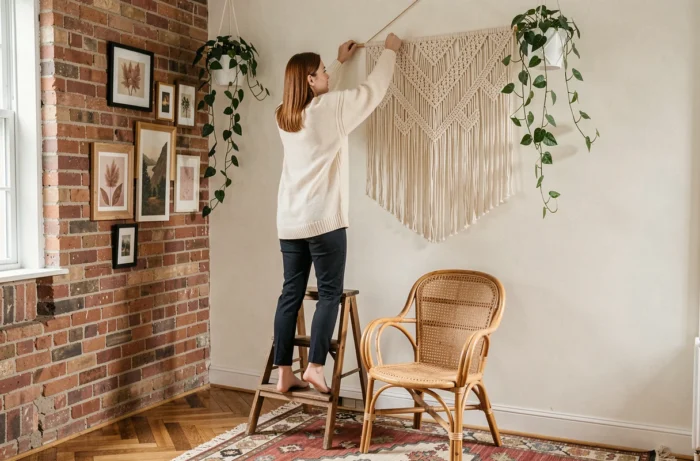
Decorative lighting: use light as a design element
Lighting changes how we perceive a space more than most decorative objects do. A single central ceiling light can make a room feel flat. Adding light sources at different heights gives the space depth and character.
Three levels of light for a living room
There’s overhead lighting (a pendant or ceiling light), mid-level lighting (a wall sconce or floor lamp), and low-level lighting (a table lamp, string lights, or candles). Combining at least two levels in each room is enough to create a warm atmosphere in the evening.
A ceramic or turned-wood table lamp also works as a decorative object. Choose one for its shape as much as its function. For added convenience, a dimmer lets you switch from task lighting to a softer glow without changing the bulb.
Lighting to highlight your walls
A wall sconce aimed upward brings out the texture of a stone or plaster wall. Pointed downward, it creates an intimate spot in a hallway or reading nook. This directional lighting turns an ordinary wall into an expressive surface, without adding a picture frame or shelf.
- A string of warm-white lights draped along a bookcase can replace a lamp while adding charm.
- An adjustable spotlight mounted on a track lets you change the look of a gallery wall without drilling new holes.
- LED strips attached beneath a shelf or behind a TV stand create a soft backlight that makes the space look larger.
Lighting is the only decor element that can change a room’s mood in a second, simply by flipping a switch. It’s also the most overlooked feature in standard interiors, where everything relies on a single central light.
Personalizing your home with charm and simplicity is all about making thoughtful choices rather than giving everything a complete makeover. A well-placed secondhand piece of furniture, a carefully chosen wall color, textiles that add texture, and layered lighting are all it takes to transform a neutral space into a place that feels like you.