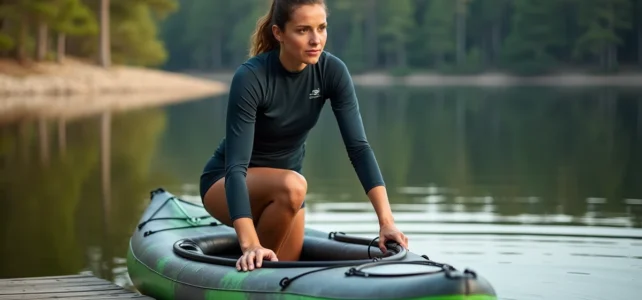
An inflatable kayak floats high on the water, with wide side tubes and a soft floor. This geometry radically changes the way of boarding compared to a rigid hull: the support point deforms under weight, the center of gravity rises, and stability depends as much on inflation as on the paddler’s position.
Inflation pressure and seating: what changes even before stepping in
The ease of boarding is determined before touching the water. An under-inflated tube bends under the pressure of your hand and tips the kayak towards the side you are boarding. Conversely, a firm inflation stiffens the structure and increases the buoyancy surface, which reduces lateral pitching at the critical moment.
Check the tension of the floor by pressing with your thumb: the surface should barely sink. If the bottom noticeably dips, add air. On models with a separate high-pressure floor, inflate the floor last to keep it taut between the tubes.
The inflatable seat provided with most inflatable kayaks raises the pelvis. Before getting in the water, adjust its position to the center of the cockpit and secure it to the attachment points. A seat that slides during boarding shifts your weight suddenly and causes exactly the imbalance you are trying to avoid. To easily get into an inflatable kayak, these adjustments on land are as important as the technique itself.
Getting into an inflatable kayak from a bank, dock, or the water
The method varies depending on the support you are using. Three situations cover almost all cases.
From a bank or a beach
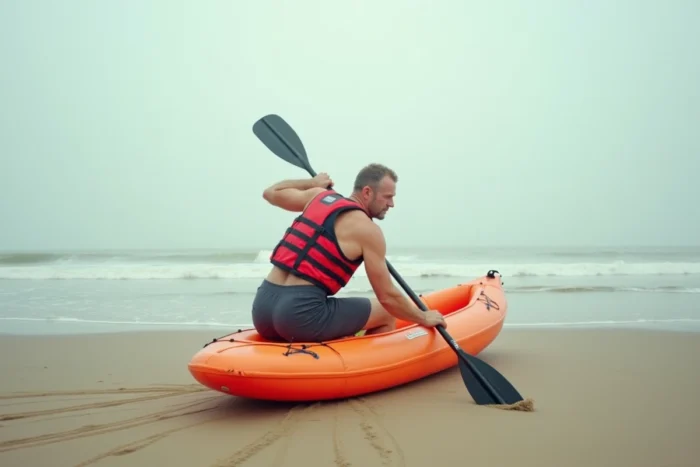
Position the kayak perpendicular to the shore, with the stern in the water and the bow on the ground. Step over the cockpit by placing both hands on the tubes, then sit down in one motion while keeping your torso low. Then push with your hands on the bottom to slide into the water. Staying low and centered prevents lateral tipping.
From a dock
Place the paddle across, one blade flat on the dock and the handle resting on the opposite tube. This “balancer” creates a temporary stabilization point. Lower yourself by first sitting on the seat (not a foot), then bringing your legs in. Your weight should fall in the center of the kayak, never on one edge.
From the water, after capsizing
This is the most delicate case, and one that no one practices until they need to. On an inflatable kayak, grabbing the tube from above flips the boat over. The technique that works: approach from the side, place both hands flat on the bottom of the cockpit (not on the tube), then pull your belly over the edge while staying horizontal. Once your torso is inside, pivot to sit down.
Getting back into an inflatable kayak alone without strength or ground support
Capsizing in deep water, with current or cold water, poses a specific problem: fatigue and cold reduce arm pulling strength in just a few minutes. The “classic” method from the side assumes a leg push that is nonexistent when you cannot touch the bottom.
Two adaptations can compensate.
- Approach from the back of the kayak, where the height of the tube is minimal. Grab the rear handle or strap, then pull yourself up flat on your stomach on the rear deck before crawling towards the seat. The kayak will tip forward, but an inflatable can handle this load without sinking due to its distributed air volume.
- Use a stirrup strap pre-attached to one of the side rings. By placing a foot in it, you convert arm pulling into leg pushing, which divides the effort. This strap can be made with a simple piece of tubular webbing tied in a loop.
- If the kayak has flipped, do not right it from the water (too much wind resistance). Go under the hull, grab the opposite tube, and let yourself fall backward to flip it. An overturned inflatable floats very high; you need to use your weight as a counterbalance, not your arms.
In all cases, retrieve the paddle before attempting to get back in. Without a paddle, you will drift after boarding, turning an incident into a prolonged situation.
Cold water, current, and wind: when not to get back in right away
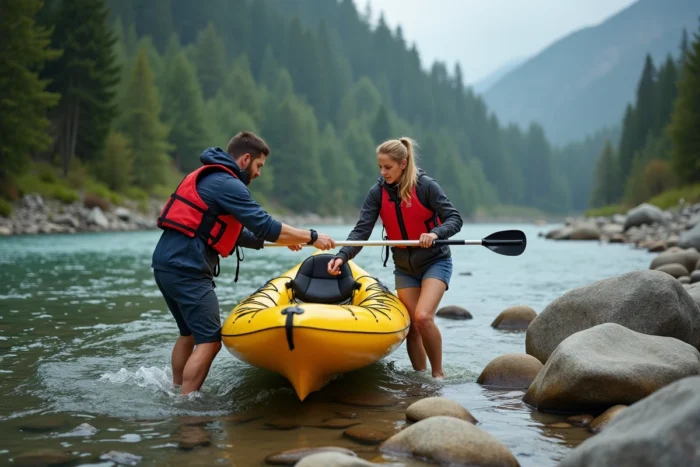
In cold water, immersion reduces muscular capacity much faster than one realizes. If after two attempts to get back in you cannot succeed, the priority changes: stay attached to the kayak and drift towards a landing point rather than exhausting yourself in the water.
A properly adjusted buoyancy vest (straps tight under the arms, not just worn) keeps the airways out of the water even without effort. In current, orient the kayak parallel to the flow to reduce drag and keep yourself upstream to avoid being pinned between the hull and an obstacle.
Crosswind pushes an inflatable kayak faster than a rigid one due to its exposed surface. If you are separated from the craft, swim towards it immediately, as the gap widens in just a few seconds.
Preparing to get back in before you leave: the gestures that change everything
Getting back in is prepared on land, not in the water. Three habits reduce the risk of being caught off guard after a capsizing.
- Practice re-boarding in calm water at the start of each season, with complete gear (vest, water shoes, paddling clothes). The maneuver differs depending on the outfit worn.
- Attach the paddle to the kayak with an elastic leash long enough to paddle normally. A lost paddle after a capsizing complicates everything else.
- Wear closed shoes with a non-slip sole. A bare foot slips on the wet tube, and the pebbles on the bottom make footing painful if you try to get back up from shallow water.
A real attempt to get back in under actual conditions is worth more than any reading on the subject. The limiting factor is almost never the technique, but the surprise and lack of repetition. Test the maneuver when the water is calm and temperate, with someone nearby, to know exactly what your body and your kayak can handle.