
Choosing a board game is based on measurable criteria: game duration, number of players, mechanical complexity, box format. Cross-referencing these parameters with the participants’ profiles (age, experience, frequency of play) allows for quickly eliminating unsuitable references. Specialized guides structure this comparison, but not all cover the same axes of analysis.
Compact formats vs expert boxes: comparative table of selection criteria
| Criterion | Compact game (cards, small format) | Expert game (standard or large box) |
|---|---|---|
| Average game duration | 15-30 min | 60-180 min |
| Typical number of players | 2-6 | 1-4 |
| Learning curve | Rules in under 5 min | Reading rules of 20 min or more |
| Footprint | Pocket format or small box | Board, miniatures, abundant materials |
| Replayability | High due to quick setup | High due to strategic depth |
| Average price | Accessible | Significantly higher |
This table highlights a structural gap. The format conditions the experience as much as the mechanics. A card game like Ark Nova in compact version and a management game with a board do not suit the same gaming situations, even if both fall under strategy.
The recent trend towards compact formats, noted during the latest editions of the As d’Or, confirms that easy-to-launch games are gaining ground in France. Easy to gift, space-saving, they reduce the entry friction for new players.
To delve deeper into these distinctions based on mechanics and profiles, Le Chaudron Des Jeux guides detail each category with sheets oriented by experience level and gaming context.

Board games for adults and solo players: a rapidly growing segment
The French market is no longer limited to gifts for children. Purchases by adults and teenagers have significantly increased in recent years, driven by motivations such as personal leisure, collecting, and social gaming among peers.
Solo gaming represents a selection axis that generalist guides often overlook. Titles like Spirit Island or Wingspan offer solo modes designed as complete experiences, not as filler variants.
How the adult profile changes selection criteria
A regular adult player does not seek the same thing as a parent buying for a birthday. The frequency of play becomes a determining parameter: a title played twice a week must offer structural replayability (variability of the board, asymmetry of factions, evolving scenarios).
- The acceptable game duration increases: a passionate adult easily tolerates two-hour sessions, whereas a family aims for thirty minutes
- The theme weighs more heavily in the decision: historical universes, science fiction, economic management guide the choice as much as the mechanics
- The budget allocated per game is higher, which opens access to titles like Everdell or Star Wars: Rebellion, whose materials justify the price
On the other hand, a beginner adult shares the same needs as a family player: short rules, quick play, accessible theme. The level of experience takes precedence over age in choosing a game.
Cooperative mechanics vs duel mechanics: what impact on the experience
The game mechanics constitute the most structuring parameter, and the one that guides treat most unevenly. Two main families dominate current recommendations: cooperation and duel (or direct competition).
Cooperation: when the common goal changes the table dynamic
Cooperative games like Sky Team or Spirit Island eliminate direct confrontation. Each player contributes to a shared goal, which radically changes the atmosphere. Cooperation reduces the frustration of the loser but requires active communication.
The main risk remains the “alpha player”: an experienced participant who dictates the actions of others. The best cooperative titles integrate limited communication mechanics (hidden cards, restricted exchanges) to counter this bias.
Duel and competition: the readability of confrontation
Two-player duel games (like competitive card games) offer a tense and readable experience. The skill progression is rapid because feedback is immediate: each action has a visible impact on the opponent.
For groups of three players or more, indirect competition mechanics (victory points, majority, area control) avoid early elimination that can ruin evenings. A good guide distinguishes these subcategories instead of lumping all competitive games under the same label.
Personalized advice and game libraries: a complement to online guides
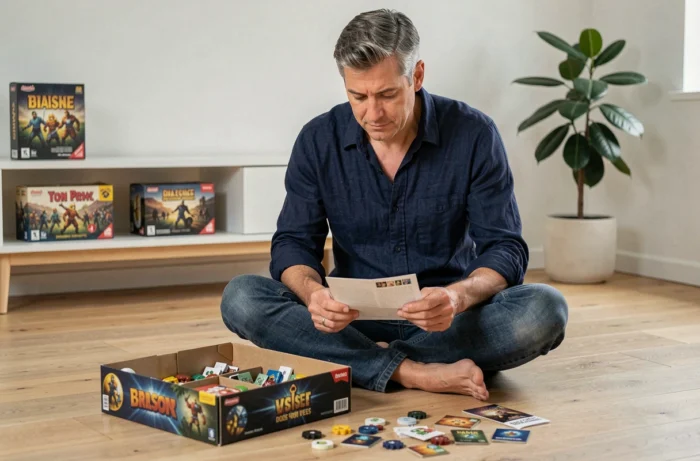
Documented feedback from municipal game libraries shows that free access and home lending transform the discovery of games. Testing a game before buying remains the most reliable filter, and spaces separated by age or type of game in these structures facilitate sorting.
A written guide, no matter how detailed, cannot replace the handling of materials or the observation of an ongoing game. Game libraries often offer supervised initiation sessions, where a facilitator adapts the suggestion to the present group.
Online guides and advice from game libraries do not oppose each other: the former allow for pre-selecting titles by objective criteria (mechanics, duration, number of players), while the latter validate the feeling in real conditions. Crossing both approaches remains the most effective method to avoid disappointing purchases and build a coherent collection.