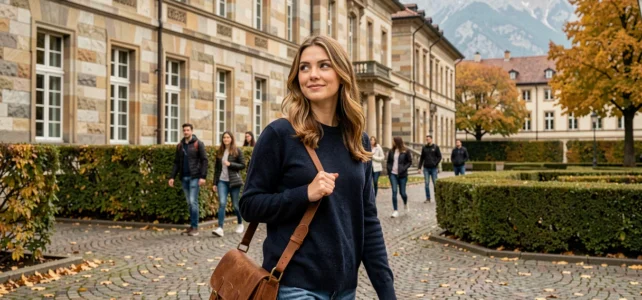
A French-speaking student applying to the University of Geneva pays moderate tuition fees. The same profile, if aiming for ETH Zurich in 2025, faces a semester fee that has risen to around CHF 2,190 for new students holding foreign degrees. This disparity well summarizes the reality of Swiss education: a high-performing system, but with conditions that vary greatly depending on the chosen institution.
Tuition fees in Switzerland: unknown gaps between universities
It is often said that Swiss universities are affordable compared to Anglo-Saxon campuses. This is generally true, but the picture deserves nuance. Fees vary greatly from canton to canton, and some cantonal universities impose a specific surcharge on foreign students where others maintain a flat rate.
Since autumn 2025, ETH Zurich and EPFL have raised their fees for some international students. New arrivals with a foreign degree now pay around CHF 2,190 per semester, while students already enrolled before this change retain the old rate. This heterogeneity creates a trap for those comparing “Switzerland” as a whole without looking at each institution individually.
In practice, it is advisable to compare the fee structures of each cantonal university before submitting an application. The total cost of a program can vary from one to three times depending on whether one studies in Zurich, Lausanne, Bern, or Neuchâtel. Detailed information on programs and admission conditions is centralized on reseau-education-suisse.ch, which facilitates this prior comparison.

Student visa and work in Switzerland: the real constraints
The other point that official brochures gloss over is the framework for student work and post-graduation stay. For a non-EU/EFTA student, work is limited to 15 hours per week during the semester. Additional constraints apply depending on the canton of residence and the type of permit.
On the post-graduation side, Switzerland does not offer an automatic long-term work visa comparable to what the UK or Canada provide. The current system allows for a job search period limited to six months after graduation. Securing a position within this timeframe requires having anticipated applications well before the end of the program.
These restrictions do not make the project impossible, but they impose a clear strategy. Here are the points to check before committing:
- The type of residence permit (B student) and its renewal conditions, which differ by canton
- The local student work rules, including authorized sectors and hourly caps
- The procedures for converting a student permit into a work permit, which require a job offer that meets Swiss salary conditions
Student housing in Switzerland: budget and market reality
Housing is the expense that surprises international students the most. University cities like Zurich and Lausanne are among the most expensive in Europe in terms of rent. Finding a room in university housing often requires several months of waiting, and spots are allocated on a list.
Shared housing remains the most common solution. Feedback varies on this point: some find a room within weeks through local platforms, while others struggle for months. Starting the search as soon as the admission application is accepted, without waiting for the final visa, saves valuable time.
Cost of living on a daily basis
Beyond rent, mandatory health insurance represents a significant monthly burden. International students must obtain Swiss coverage or prove equivalence, which generates additional administrative steps. The budget for food, transportation, and everyday expenses adds to a cost of living that is significantly higher than the European average.

Programs and teaching: what makes the difference on the ground
The Swiss education system combines theoretical teaching with practical orientation, with a notable feature: many master’s programs are offered in English, even in French or German-speaking universities. For an international student, this simplifies access without exempting them from learning the local language, which is necessary for internships and professional integration.
The multilingual environment of the country (French, German, Italian, Romansh) is a concrete asset for sciences, business, and engineering. The campuses in Zurich and Lausanne host research laboratories connected to industry, giving students direct access to projects funded by Swiss and international companies.
- Technical universities (ETH Zurich, EPFL) are regularly ranked among the best in the world in sciences and engineering
- Swiss hospitality management schools enjoy unique sector recognition, with integrated internships starting in the first year
- Doctoral programs generally offer a salary, which distinguishes Switzerland from many countries where the doctorate remains self-funded
Choosing a field of study in Switzerland is not just about the reputation of a ranking. It is the compatibility between the program, the canton, and the professional project that determines success. A program in sciences in Zurich and a master’s in hospitality in Lausanne do not imply the same budget, the same opportunities, or the same living environment. Asking these concrete questions before applying avoids unpleasant surprises once on site.