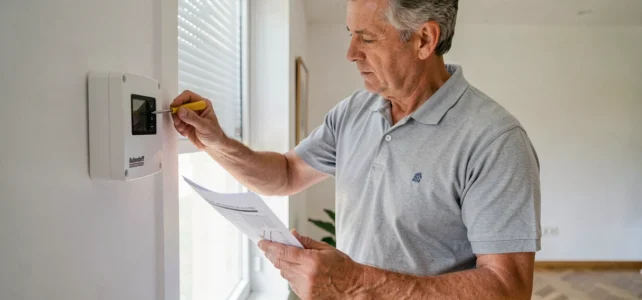
The adjustment of end stops on a Bubendorff radio roller shutter does not follow a single procedure. The sequence varies depending on the motor generation, the type of remote control, and the manufacturing date of the shutter. Precisely identifying the model before any manipulation prevents blocking the motor or losing the memory of recorded positions.
Motor RG, ID2, MVB-16: differences in procedure by generation
Competitors treat the fine adjustment of end stops as a standard operation. The technical reality is more fragmented. Bubendorff has produced several generations of radio motors, and each generation incorporates a different programming logic.
| Motor Generation | Reset Method | Sequence to Enter Adjustment Mode |
|---|---|---|
| RG (recent) | Reset + automatic learning of positions | Simultaneous press of up/down then validation |
| ID2 / ID3 (older) | Manual reset with a specific sequence for the remote control | Combination with Bubendorff button on certain models |
| MVB-16 (intermediate) | Adjustment mode via power cut then button sequence | Variable depending on the associated remote control |
This diversity explains why a method found online may not work on your installation. The motor generation dictates the entire procedure. Before touching anything, locate the exact reference on the motor label or in the shutter box.
Mastering the fine adjustment of a Bubendorff roller shutter therefore first requires a diagnosis of the model, not a blind manipulation.
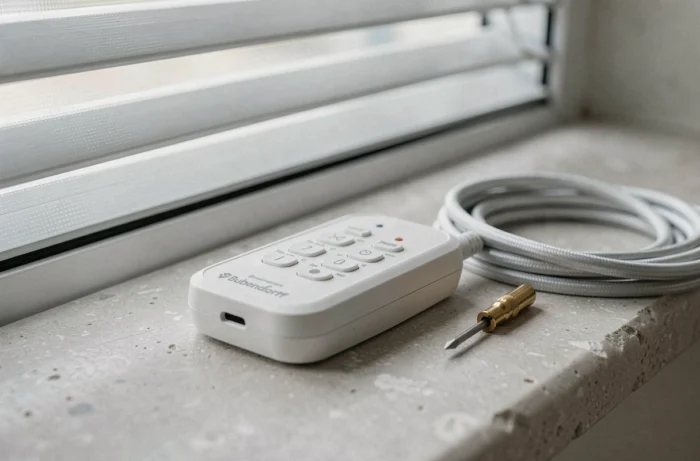
Power Cut and Memory Loss: A Common Trap on Radio Motors
On a wired motor, the end stops are often mechanical. On a Bubendorff radio motor, they are stored in the motor’s electronics. This difference has a direct consequence: a prolonged power cut, a surge, or a simple tripped circuit breaker can erase the recorded positions.
The curtain then no longer stops at the right place. It rises too high and forces against the box, or descends beyond the closed position. The motor experiences abnormal mechanical stresses that accelerate its wear.
Symptoms to Distinguish from a Motor Failure
A shutter that no longer responds after a power cut is not necessarily broken. Confusion is common, and it sometimes leads to unnecessary motor replacement.
- The curtain stops mid-course for no apparent reason: the upper or lower end stop has been erased, and the motor no longer knows where to stop
- The shutter moves up or down in brief jerks and then stops: the remote control is unpaired from the radio receiver, no mechanical problem
- The motor does not respond to any command after power restoration: a complete reset of the radio motor is necessary before any adjustment
In the first two cases, a simple recalibration of the positions is sufficient. The third case requires re-pairing the remote control and motor before being able to access the adjustment mode.
Grouped Control and Diagnosis of False Misadjustment
Recent Bubendorff radio motors include a grouped control feature. Multiple shutters can be controlled from the same transmitter, or a shutter can receive commands from several remote controls.
This operation creates a misleading diagnostic scenario. A shutter seems poorly adjusted (it stops at an unexpected position or does not always respond), while the problem arises from a conflict between transmitters. A shutter controlled by two remote controls can receive contradictory commands.
Before modifying the end stops, check how many transmitters are paired with the motor. On models compatible with additional transmitters, the product sheet explicitly indicates the pairing capacity. If an old transmitter remains in memory after a remote control replacement, it may interfere.
Identifying a Transmitter Conflict
Cut the power to the affected shutter. Restore power and immediately test with a single remote control. If the shutter responds normally and stops at the correct positions, the problem is not a misadjustment of the end stops. It is a multi-transmitter control conflict that requires removing unwanted pairings.

Fine Adjustment Sequence on Bubendorff Radio Motor: Variables to Control
Once the model is identified and transmitter conflicts are ruled out, the actual adjustment relies on three parameters.
The first is the upper position of the curtain. It corresponds to the stop point when rising. The curtain must fully roll into the box without forcing against the mechanical stops. An adjustment too high causes a characteristic slamming noise.
The second parameter is the lower position of the curtain. The shutter must descend to complete closure, with slight pressure on the window sill to ensure sealing. An adjustment too low forces the motor at each closure.
The third is the reaction time between pressing the button and confirming the position. On RG motors, the sequence is quick: press up and down simultaneously to enter adjustment mode, then validate each position with a brief press. On ID2 models, the combination sometimes involves the dedicated Bubendorff button, and the validation delay is shorter.
Functionality Test After Adjustment
Perform at least three complete up-down cycles after recording the new positions. The radio motor electronically memorizes the end stops, but a confirmation cycle stabilizes the recording. If the curtain exceeds the programmed position during the second or third cycle, the memorization did not take correctly. Restart the procedure from the reset.
On Bubendorff radio roller shutters, adjusting the end stops remains an accessible operation, provided you start from the correct diagnosis. The motor generation, the state of the remote control pairing, and the history of power cuts determine the course of action much more than the manipulation itself.