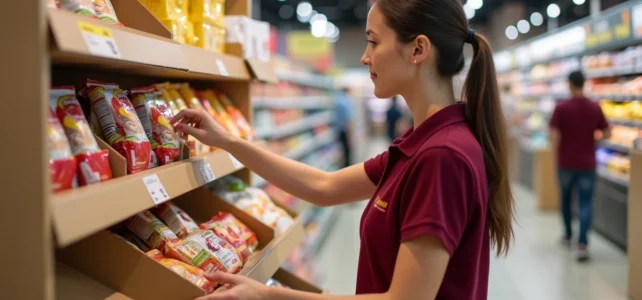
POS, or point-of-sale advertising, refers to all advertising materials deployed in a commercial space to direct attention towards a product or an offer. It is distinct from ILV (information at the point of sale), which aims to guide the customer in the store without direct promotional intent. Understanding this boundary is the starting point for optimizing POS at the point of sale without diluting its effect within the overall merchandising strategy.
Isolating the POS effect from the rest of the in-store setup
When sales increase after the installation of a display, the temptation is to attribute this result solely to the POS. In reality, sales promotions, merchandising, and ILV contribute simultaneously to conversion. A shelf stop placed next to a reconfigured end cap and a temporary promotion creates a combined effect that is difficult to break down.
To approach the true ROI of an advertising support in-store, a common method is to compare the performance of two similar points of sale: one equipped with POS, the other without. This field A/B test helps neutralize variables related to location, seasonality, or a parallel commercial operation.
Better understanding POS at the point of sale helps frame what each support can actually achieve, and what falls under other levers.
Without this measurement rigor, POS budgets are renewed out of habit rather than proven effectiveness. A support whose impact is not measured always ends up losing its budget.

Choosing the POS support: material, format, and lifespan
The type of support determines both the cost, durability, and perception of the highlighted product. Generally, two families are distinguished: temporary POS and permanent POS.
Temporary cardboard POS
The cardboard display remains the most common format for short-term operations (product launch, seasonal promotion). Its manufacturing cost is low, it assembles without tools, and it can be recycled at the end of the campaign. In return, it does not withstand humidity and repeated handling well. Its effective lifespan rarely exceeds a few weeks in real store conditions.
Permanent POS: metal, wood, plexiglass
Durable supports (metal, wood, plexiglass) are suitable for long-term placements. They convey a more qualitative image and can support heavier loads. The initial extra cost is justified when the product remains on the shelf for several months and the support can be restocked without complete replacement.
The choice between these two families depends on three concrete criteria:
- The expected duration of the commercial operation: below four weeks, cardboard is sufficient in most cases
- The weight and volume of the displayed products: an undersized support collapses and degrades the brand image
- The logistical constraints of the point of sale: a piece of furniture that can be assembled in ten minutes by store staff is more likely to be actually installed
In-store location: where POS converts best
A perfectly designed advertising support but poorly placed produces no results. The location determines visibility even before design.
High-traffic areas (store entrance, main aisles, checkout areas) naturally attract more attention. The end cap remains the most contested location in large retail because it is situated on the natural flow of traffic.
Conversely, a display placed in a secondary aisle or at the back of the shelf reaches an audience already engaged in a specific search. The conversion rate there is sometimes higher, even if the volume of contacts is lower. This is typically the suitable location for a niche product or a premium upgrade.
The intersection of traffic flow and purchase intent guides optimal placement. An impulse product (candy, accessory, low price) performs better at the checkout area. A technical or premium product benefits from being presented in its shelf universe, with a support that provides information.
Eco-design and environmental claims on POS
POS supports are increasingly designed with eco-design constraints integrated from the specifications: recycled or recyclable materials, weight reduction to limit the logistical footprint, and proactive end-of-life management. This evolution is not just a marketing argument.
The compliance of messages displayed on supports has become a standalone issue. Vague claims like “eco-friendly,” “green,” or “environmentally friendly” are becoming less acceptable without precise, measurable, and verifiable evidence from an independent third party. A display that makes an unsupported environmental claim exposes the brand to reputational risk and, ultimately, regulatory risk.
In practical terms, this means that the wording printed on a POS support must be validated with as much care as the visual. A vague environmental message on a display discredits the product it is supposed to enhance.
Interactive POS: QR codes, kiosks, and digital extension
In the face of visual saturation in stores, some POS devices integrate interactive elements to extend the contact time with the customer. The QR code printed on a display links to a product sheet, a video, or a promotional code. The touchscreen kiosk allows for consulting an expanded catalog without multiplying physical references on the shelf.
These formats respond to a more fragmented shopping journey, where the customer alternates between online browsing and in-store visits. Interactive POS does not replace the physical support: it enhances it by capturing attention that the visual alone no longer retains long enough.
The interest is measured by the scan or interaction rate, which offers an advantage rarely associated with traditional POS: a performance data point that is directly traceable. Each QR code scan becomes a concrete measurement point, where the traditional cardboard display provides no exploitable metrics without manual counting.
The next POS campaign in-store will benefit from being thought of not as a static display, but as a measurable contact point, understated in its materials and precise in its message. It is this combination that separates a decorative support from a selling support.