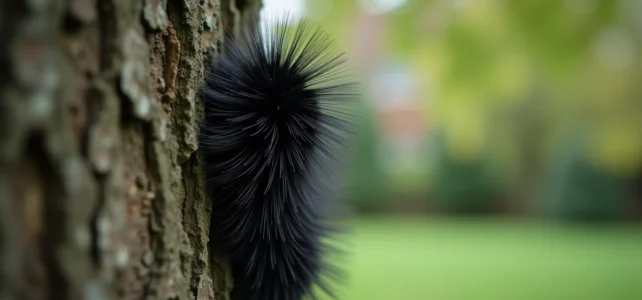
Several dozen species of caterpillars frequent French gardens, and many of them have a dark body covered in hairs. When encountering a hairy black caterpillar at the foot of a fruit tree or on a hedge, the first instinct is often to think of the processionary caterpillar. The confusion is understandable, but it can lead to disproportionate reactions or, conversely, to negligence in the face of a truly stinging species.
Correctly identifying the caterpillar in front of you requires observing a few specific criteria, accessible without special equipment.
Observation criteria to recognize a hairy black caterpillar
Overall color is not enough. Two “black and hairy” caterpillars can belong to very distant families, with opposing risk levels. What helps to differentiate them is a combination of morphological details and context.
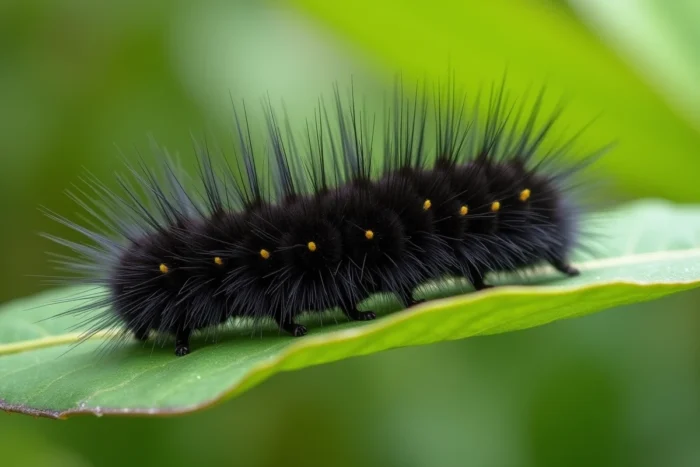
- The arrangement of the hairs: tufts organized in regular rows along the back often indicate a bombyx (oak bombyx, disparate bombyx), while fine and short hairs distributed more uniformly point towards processionaries.
- Dorsal markings: a clear midline, orange or bluish lateral spots, colored warts at the base of the hairs are all clues. The dressed bombyx (Malacosoma neustria) for example has a distinct white stripe on its back, which is absent in the oak processionary.
- Collective behavior: processionaries move in a single file and weave visible silky nests in pines or oaks. A solitary hairy black caterpillar found on a bramble or rosebush is very unlikely to be a processionary.
- The host plant: pine processionaries colonize conifers (black pine, maritime pine, Scots pine, cedar), while oak processionaries are restricted to broadleaf trees of the genus Quercus. A black caterpillar spotted on an apple tree or a plum tree points towards other species, such as the bramble bombyx (Macrothylacia rubi).
By cross-referencing these four elements (hair arrangement, markings, behavior, host plant), the range of possibilities is significantly reduced. To identify a hairy black caterpillar on Actu Animaux, the method relies on a similar visual cross-referencing logic.
Stinging or harmless hairy black caterpillars: species to distinguish
The real issue behind identification is to know whether the caterpillar poses a health risk. The majority of hairy black caterpillars encountered in gardens are harmless. Their hairs are irritating to the touch for sensitive skin, but nothing more.
Species with real risk
The pine processionary (Thaumetopoea pityocampa) and the oak processionary (Thaumetopoea processionea) are the only common caterpillars in metropolitan France whose stinging hairs cause serious allergic reactions: skin irritations, respiratory issues, conjunctivitis. The brown-tail moth (Euproctis chrysorrhoea) also has stinging hairs, but the reactions it provokes are generally milder.
Stinging hairs remain active for several months after the caterpillars have left, including in abandoned nests and on the ground below. A garden can therefore pose a risk even in the absence of any visible caterpillar, as noted by the ARS Auvergne-Rhône-Alpes in its prevention sheets.
Species often confused, but harmless
The disparate bombyx (Lymantria dispar) is recognized by its well-marked blue and red dorsal warts. The oak bombyx (Lasiocampa quercus) has tawny sides contrasting with a darker back. The cherry lappet (Eriogaster lanestris), stout and very hairy, lives in colonies on fruit trees but does not have stinging hairs.
Most hairy black caterpillars in the garden are harmless to humans. The instinct to crush them or treat them chemically deprives the garden of pollinating butterflies and useful links in the food chain of insectivorous birds.
Stinging hairs in the garden: a risk that persists on the ground
This point is rarely mentioned in gardening guides. The stinging hairs of processionaries are not permanently attached to the caterpillar. They detach in the wind, settling on the grass, clothes left outside, children’s toys. The winter nests of pine processionaries, even when empty, remain laden with these microhairs for a long time after the emergence of adult butterflies.
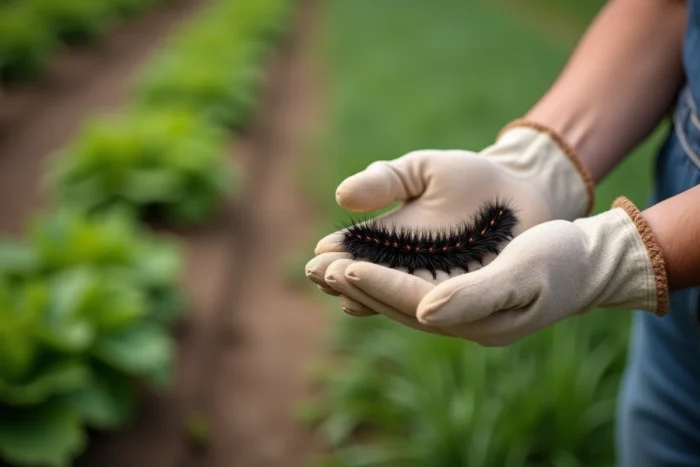
Never handle a processionary nest with bare hands, even if it seems abandoned. Using thick gloves and a sealed bag is the minimum precaution. For nests located high up, calling in a professional remains the safest solution.
In recent years, municipalities and regional health agencies have been conducting targeted reporting and vigilance campaigns, with public displays and specific instructions for private gardens. This regulatory increase reflects the geographical expansion of oak processionary outbreaks observed in several regions since the mid-2020s.
Life cycle and appearance period of hairy black caterpillars
The time of year when you observe the caterpillar provides an additional clue for identification. Pine processionaries are mainly seen between January and May, with appearances as early as October in areas with an oceanic climate. Oak processionaries are visible later, generally between April and July.
The bombyx, on the other hand, follow staggered cycles. The bramble bombyx overwinters as a larva and resumes activity in spring. The disparate bombyx lays its eggs in plaques on the trunks, and the young larvae hatch in the following spring, often confused with young processionaries when they are still small and dark.
Observing the stage of development also helps. A hairy black caterpillar less than one centimeter, spotted in March on an oak, could correspond to a young oak processionary or a larva of the disparate bombyx. At this early stage, the distinctive markings are not very visible, and waiting a few days before concluding often allows for clearer identification as characteristic patterns appear with subsequent molts.
The complete cycle, from egg to adult butterfly, spans several months depending on the species. The eggs, laid on leaves or branches, hatch into larvae that go through several stages before pupation. Spotting the egg masses (plaques of eggs covered in scales in the disparate bombyx, grayish sheaths around pine needles in the processionary) gives a head start in anticipating the presence of caterpillars in the following weeks.
When faced with a hairy black caterpillar in the garden, the most useful action is to not touch it, to photograph the animal with a scale reference (a coin, a gloved finger next to it), and to note the plant on which it was found. These three pieces of information are usually sufficient to obtain a reliable identification from a naturalist forum or a competent municipal service.