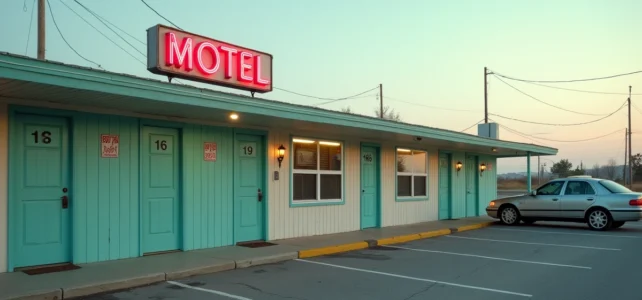
Have you ever driven on an American highway and noticed those low buildings where you park right in front of your room? This type of accommodation has a specific name: the motel. A contraction of “motor” and “hotel,” the motel refers to an establishment designed for passing motorists. Understanding what distinguishes it from a traditional hotel allows for better accommodation choices based on budget, service expectations, and security requirements.
Direct parking access and low architecture: the DNA of the motel
The motel is recognized by its structure. The rooms open directly onto the parking lot, often at ground level or on a maximum of two floors. No imposing lobby, no elevator, no endless corridors.
This configuration is not by chance. It meets a specific need: to allow travelers to park in front of their door, unload their luggage in seconds, and leave early in the morning without going through a reception. The motel was designed for road trips, for a one-night stop between two legs of a journey.
A hotel, on the other hand, organizes its spaces around a central building. The reception, restaurant, gym, or pool occupy common areas. The rooms are spread over several floors, accessible via interior corridors. The architecture reflects a logic of longer stays, with integrated services.
By digging into the definition of a motel versus a hotel, we understand that the fundamental difference lies in this logic of direct access from parking. Everything else follows from this: the size of the building, the number of services offered, and the displayed rates.
Services offered in a motel and in a hotel: a narrowing gap
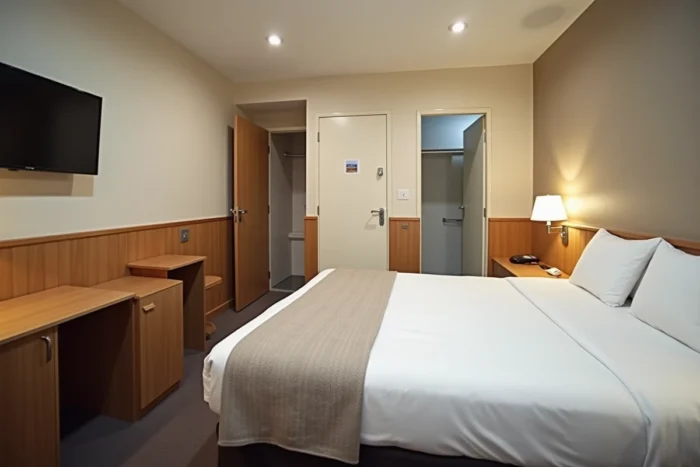
The traditional motel offers the bare essentials. A room with a bed, bathroom, sometimes a television. No room service, no concierge, rarely a restaurant on-site. The traveler arrives, sleeps, and leaves.
The hotel offers a much broader range of services. Depending on its classification, it may include:
- A dining service (breakfast, bar, restaurant), sometimes available in-room
- A wellness area or pool, with dedicated staff for reception
- A reception open continuously, luggage service, and concierge
Do you think the motel remains stuck in this minimalist image? Budget motel chains have changed the game. Brands like Motel 6, Super 8, or Travelodge now offer free Wi-Fi, loyalty programs, and sometimes a reception open 24/7 on major routes. These standards bring them closer to budget hotels.
The line between budget motel and low-cost hotel is therefore becoming blurred in terms of services. What still separates them is the structure of the building and the type of clientele targeted: the motel remains focused on very short stays, one or two nights, while the hotel also accommodates business travelers or tourists on extended stays.
Security in motels and hotels: different approaches
The question of security often arises when discussing motels. Direct access to rooms from the outside, without passing through a monitored lobby, raises legitimate concerns.
In a hotel, security relies on several filters. Mandatory passage through the reception, electronic badges to access floors, the presence of staff at all times, and video surveillance of common areas create a multi-layered system. High-end establishments may employ dedicated private security agents.
The motel compensates through other means
A well-managed motel installs cameras in the parking lot and around the rooms. Electronic locks are gradually replacing mechanical keys. Outdoor lighting also plays a deterrent role, especially on isolated routes.
The level of security varies greatly from one motel to another. A chain establishment applies standardized protocols (cameras, lighting, emergency procedures). An independent motel in a rural area may not always have the same resources. Before booking, checking recent reviews on cleanliness and parking security provides a reliable indication.

Price of a motel and a hotel: what explains the price gap
The motel generally costs less than a hotel of equivalent category. The reason is structural: less staff, fewer services, fewer square meters of common areas to maintain.
A hotel finances its permanent reception, daily cleaning of common areas, dining services, and night staff. These costs are reflected in the room price. The motel, with its lightweight structure, reduces these expense items.
A gap that narrows in high season
On heavily trafficked routes or during peak demand periods, the price difference between a chain motel and a budget hotel can narrow significantly. Rates for motels located near major tourist destinations rise during school holidays or long weekends.
The pricing structure of a motel remains simpler than that of a hotel. Few extras, no high tourist tax related to star ratings, rarely any fees for parking (since it’s part of the concept). For budget-conscious travelers, the motel remains the most economical choice for a roadside stop.
Motel or hotel: selection criteria based on the type of trip
The right accommodation depends on the context of the trip, not on a value judgment between the two options. A few concrete guidelines help make a decision:
- For a road trip with short stops (one night per city), the motel offers the flexibility and price that fits
- For a stay of several nights in the same city, the hotel provides the comfort of integrated services (dining, workspace, daily cleaning)
- For a business trip, the hotel remains the default choice due to its continuous reception and meeting rooms
- For a family traveling with a lot of luggage, the motel simplifies loading and unloading thanks to parking in front of the door
The motel is neither a discount hotel nor an outdated accommodation. It is a type of establishment that meets a specific need: to sleep comfortably during a road trip, without paying for services that are not needed. When you understand this logic, the choice between motel and hotel becomes a practical question, not a question of status.